
Free Quote
Contact us today for your Free Quote

Origins and Early History
Valentine’s Day is widely recognised as a celebration of romantic love, marked by cards, flowers, chocolates, and shared experiences. Yet behind the familiar imagery lies a complex history shaped by religion, folklore, commerce, and changing social values. Today, the day also carries a growing environmental footprint, prompting renewed scrutiny of how it is celebrated and how its associated waste is managed.
The origins of Valentine’s Day are commonly linked to one or more Christian martyrs named Valentine, with the most cited figure being Saint Valentine of Rome. According to legend, he defied Emperor Claudius II’s ban on marriage for young soldiers by secretly performing weddings. When discovered, Valentine was imprisoned and later executed on 14 February, around the year 269 CE. Over time, his story became associated with themes of loyalty, devotion, and sacrificial love.
However, the date itself may have older roots. Some historians connect Valentine’s Day to the Roman festival of Lupercalia, held in mid-February. Lupercalia was a pagan fertility ritual involving symbolic acts of purification and matchmaking. As Christianity spread, it was common for existing festivals to be adapted or replaced with Christian observances, and Valentine’s Day may represent one such transition.
By the Middle Ages, Valentine’s Day had begun to take on a more explicitly romantic character. In England and France, it was believed that birds began pairing in mid-February, reinforcing associations with courtship. The poet Geoffrey Chaucer referenced this belief in his 14th-century work Parlement of Foules, helping to embed the idea of Valentine’s Day as a celebration of romantic pairing in European culture.
The Rise of Cards and Commercial Traditions
By the 18th century, Valentine’s Day customs had become more formalised. Exchanging handwritten notes and small tokens of affection was common. These early “valentines” were often personalised and poetic, reflecting the social norms of the time.
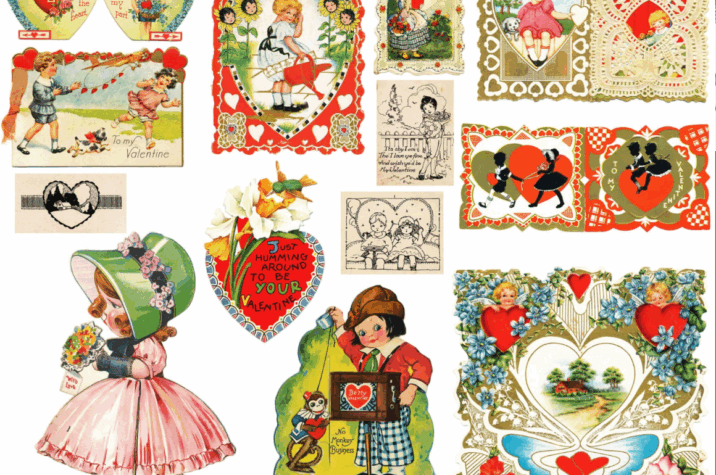
The 19th century, especially the Victorian era, marked a turning point. Advances in printing technology made mass-produced Valentine’s cards affordable and widely available. Decorative cards featuring lace, ribbons, and romantic imagery became popular, transforming Valentine’s Day into a commercial event. The introduction of the penny post in the UK further accelerated this trend by making it easier and cheaper to send cards anonymously.
From this point onward, Valentine’s Day became increasingly linked to consumer culture. Chocolates, flowers, and jewellery emerged as symbolic gifts, many of which remain central to modern celebrations. While these traditions are now global, their roots lie in a relatively recent intersection of romance and retail.

How Valentine’s Day Is Celebrated Today
In contemporary society, Valentine’s Day is celebrated in diverse ways. For some, it remains focused on romantic partnerships, with couples exchanging gifts, dining out, or taking short breaks together. For others, the day has broadened to include expressions of friendship, self-care, and family appreciation.
Digital communication has also reshaped the occasion. E-cards, social media posts, and online gifting platforms have reduced reliance on traditional post, while also expanding the reach and immediacy of Valentine’s messages. At the same time, physical gifts remain dominant, particularly flowers and confectionery, which are strongly associated with the day’s symbolism.
Globalisation has further diversified Valentine’s Day traditions. In Japan, for example, women traditionally give chocolate to men on 14 February, with the gesture often reciprocated a month later on White Day. In many countries, local customs blend with imported traditions, creating region-specific interpretations of the celebration.
The Environmental Cost of Valentine’s Day
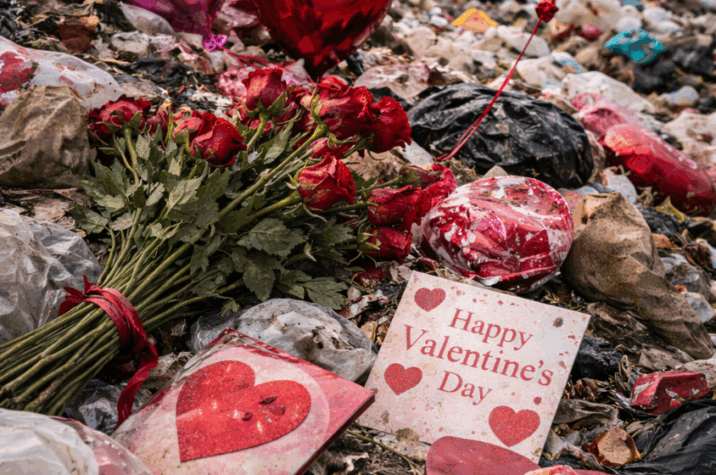
While Valentine’s Day is emotionally significant for many people, its environmental impact is substantial. The increased consumption associated with the day generates a spike in waste across several key streams.
Cards are a notable example. Millions of Valentine’s cards are exchanged each year, many featuring glitter, foil, or plastic coatings that complicate recycling. Similarly, gift packaging often includes mixed materials that are difficult to separate and process.
Flowers, particularly imported roses, carry a hidden carbon cost. Many are grown in heated greenhouses or transported long distances by air freight, contributing to greenhouse gas emissions. Once the celebrations end, flowers are frequently discarded, adding to organic waste volumes.
Food and confectionery also contribute to Valentine’s Day waste. Chocolate packaging commonly includes plastic trays, foil wraps, and cardboard sleeves. Romantic meals, whether cooked at home or eaten out, can lead to increased food waste if portions are misjudged or surplus food is discarded.
Together, these factors mean that Valentine’s Day is not just a cultural event, but also a moment of intensified environmental pressure.
Valentine’s Day, Sustainability, and Waste Reduction
As awareness of climate change and resource scarcity grows, many people are reconsidering how they celebrate occasions like Valentine’s Day. Sustainability-focused alternatives are becoming more common, including:
- Choosing experiences over physical gifts, such as shared activities or charitable donations
- Opting for recyclable or compostable cards and packaging
- Supporting local florists who source seasonal flowers
- Reducing food waste through careful planning and reuse
These choices align with broader principles of the waste hierarchy: prevention first, followed by reuse and recycling, with disposal as a last resort.
The Role of Bywaters
In this context, waste and resource management providers play a critical role. Bywaters supports businesses and communities in managing the increased waste associated with seasonal events like Valentine’s Day, while also helping to reduce environmental impact at source.
Through comprehensive recycling services, food-waste collections, and data-led reporting, Bywaters enables organisations to understand exactly what waste they generate and how it is treated. This transparency supports better decision-making, whether that involves reducing single-use materials, improving recycling performance, or redesigning procurement practices.
Bywaters’ focus on innovation and sustainability helps ensure that unavoidable waste is managed responsibly, with priority given to recycling and recovery rather than landfill. In doing so, the company supports a more circular approach to celebration; one where moments of connection and generosity do not come at the expense of the environment.
More posts:

Tips to Secure Your Bins & Avoid Damage Charges
Properly positioning and handling your Bywaters bins can help prevent damage, reduce the risk of fly-tipping and keep your waste collection area safe and accessible.
Read more
Community Solutions For Drought Resilience: How Working Together Can Secure Our Water
Discover how communities can build drought resilience through water conservation, sustainable landscaping, education, and local partnerships.
Read more
Reducing Your Water Footprint Beyond The Tap: Simple Ways To Save Water During A Drought
At Bywaters, we put sustainability first, assisting organisations. Reducing hidden water use helps protect water resources, supports ecosystems, and ensures there is enough water for communities and agriculture.
Read more
Share: